In this article
The word “trained” can compress several different facts. A person may have opened a module, completed its required steps, passed an assessment, explained an idea or received permission for a particular assignment. Those facts may be related, but one should not be silently substituted for another. This independent notebook helps readers keep the distinctions visible without interpreting anyone’s employment record.
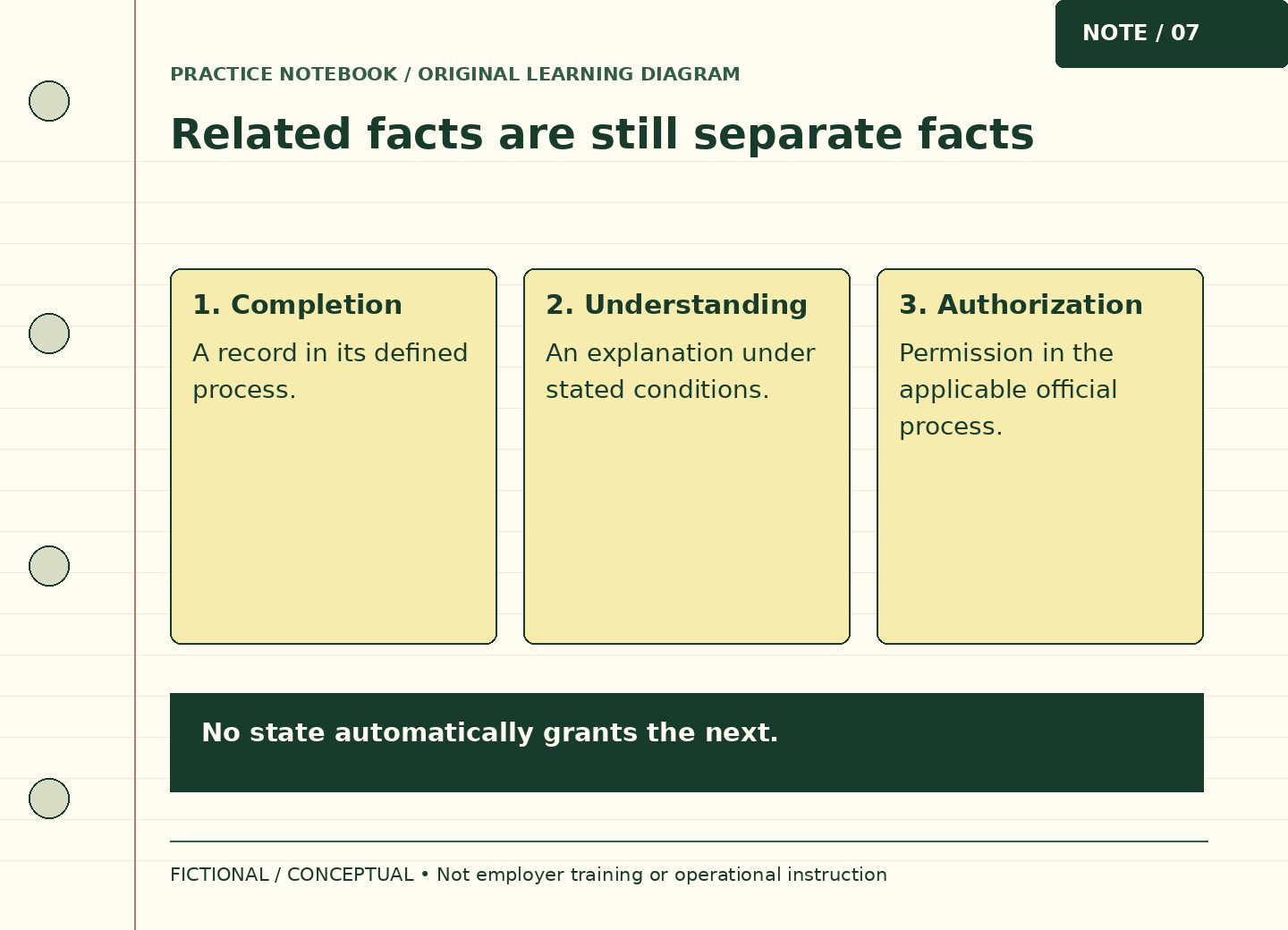
Completion is a record with a defined scope
A completion record normally refers to a particular item in a particular process. Its meaning depends on what the process requires and what the record actually says. A personal note that a page was read is not the same thing. Neither a printout from this website nor a finished Practice Evidence Lab prompt creates an employer course record.
If an official status is missing or unclear, use the authorized support route. Do not infer completion from a browser tab, a screenshot of a final screen or a recollection of clicking through. This publication cannot inspect or repair employee records, and it does not ask readers to send them.
Understanding needs an appropriate question
Explaining an idea in your own words can reveal something about understanding, but the question and conditions matter. Explaining a fictional rule with the reference open is different from applying an approved rule in an assessed setting. A narrow personal exercise should lead to a narrow conclusion about that exercise.
For example, a learner may correctly explain why an unlabeled book remains unresolved. That is useful evidence about the invented classification task. It does not establish that the learner knows the current requirements of a security-service assignment. The domain knowledge, consequences and authorized assessment are different.
Authorization belongs to the applicable process
Permission to perform work may depend on requirements outside a personal learning exercise. This notebook does not identify or interpret those requirements for an individual. Required training, licensing, assessment, supervision and assignment approval must come from the applicable official sources. Do not use a general article as permission to perform a task.
When the distinction is unclear, frame the question precisely: which requirement is complete, what record confirms it, and who can verify permission for the actual role or task? This is a training-literacy question, not a workaround. A missing answer is a reason to obtain clarification, not to assume that one status implies every other status.
Read the public portal for its limited purpose
Allied Universal’s public login portal labels EDGE as the employee learning management system. It separately provides other employee and candidate routes. This page only establishes where the company points readers publicly; it does not establish which courses are assigned, whether access is active or what any user has completed.
Use the official portal and the verified instructions supplied through your workplace. This site supplies no login form, password field, account proxy or recovery service. It is deliberately designed as an independent reading notebook, so no reader should mistake a practice worksheet for an employer screen.
Keep your language as precise as your evidence
“I read the article,” “I completed the fictional exercise,” “the official record shows completion,” and “the authorized process confirmed permission” are distinct statements. Use the one that matches the evidence you actually have. Do not upgrade a practice result to sound more impressive, and do not downgrade a genuine official record into a vague personal impression.
Read the learning-log guide for a way to preserve these boundaries in personal notes. The goal is not to accumulate labels. It is to know which question has been answered and which question still belongs to an authorized person or system.