In this article
A useful learning log preserves the meaning of an attempt. It does not need to be long, impressive or full of certificates. Four precise lines can tell you more than a page saying “training completed.” The aim is to make future reflection possible without creating an unofficial employee record, copying internal documents or claiming competence that the exercise did not establish.
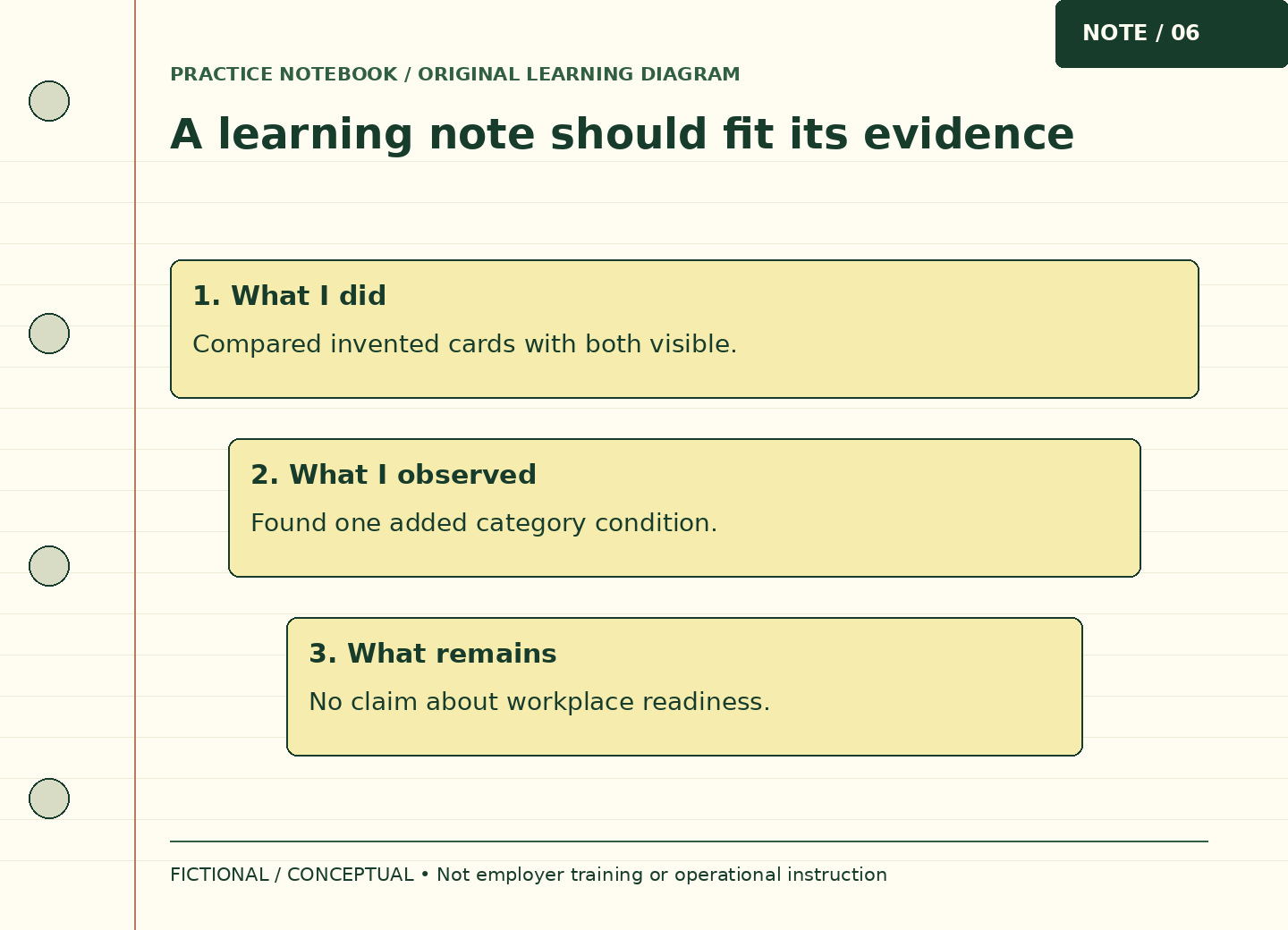
Record the task and the conditions
Start with what you actually did. “Compared fictional sorting cards A and B with both visible” identifies an activity and a condition. “Learned document control” is much broader than the evidence. Add the date of your personal exercise if it helps you organize your own notes, but do not turn that date into a course completion or employer approval date.
The conditions are part of the evidence. A correct answer with a reference open differs from a correct unaided explanation. A familiar example differs from a new example. An attempt reviewed by yourself differs from an authorized assessment. None needs to be disguised; clarity about conditions makes a modest record more trustworthy.
Write an observation that points to an artifact
An observation should let you locate the relevant part of the attempt. “Found the added category condition, but missed the unchanged yellow-label rule” gives you something to inspect. “Getting much better” may express a feeling, but it does not identify the evidence behind it. You can keep both kinds of reflection if you label them differently.
Keep the observation proportionate. If you checked four invented items, say what happened with those four items. Do not extrapolate to all tasks, all situations or a general readiness rating. A personal log is strongest when it preserves the boundaries of what was tried.
Keep a next question, not a verdict
The next line can ask what you still want to learn: “Can I identify the same kind of added condition with different labels?” This leads to another purposeful exercise. A verdict such as “qualified” closes the question without supplying the required assessment. The notebook does not issue qualifications, completion certificates or badges.
If the question concerns required training, assignment status or a missing official record, take it to the authorized training process. A personal learning log cannot repair an employer system or substitute for a formal record. Keep a note that a question needs confirmation rather than entering a guessed completion status.
Minimize what you keep
Use invented examples or public material you are allowed to retain. Do not add employee identifiers, client names, visitor details, screenshots, incident records, access arrangements, internal procedures or private course content. A general learning observation can usually be expressed without them. If it cannot, the personal log may be the wrong place for it.
This website does not provide a cloud notebook or an upload feature. The Practice Evidence Lab keeps only fixed choices and generated prompts in current-page memory. If you print a prompt or copy a reflection into your own file, you decide where that artifact goes and who can see it. Follow applicable workplace rules for any real training record.
Review the log for honest language
Before reusing a note, ask whether the wording still matches the evidence. “Practiced classification using a fictional reference” is supported by the activity. “Certified in operational decision-making” is not. If you later complete authorized training, keep its genuine record in the appropriate system rather than retroactively upgrading an old practice note.
Allied Universal’s public portal identifies EDGE for employee learning. It does not expose your assignments to this publication. Read the boundary between learning and authorization when deciding where a record belongs. A clear, limited note is useful precisely because it does not pretend to be something larger.