In this article
A learning goal becomes easier to work with when the result is visible. “Get better at organizing information” is a direction, but it does not tell you what to practice or how to inspect the attempt. This notebook starts with a smaller unit: an invented task, one observable move and one criterion. It is suitable for ordinary learning reflection by security-service workers, without reproducing employer procedures or assessing anyone’s readiness for duty.
Choose a harmless task with a clear edge
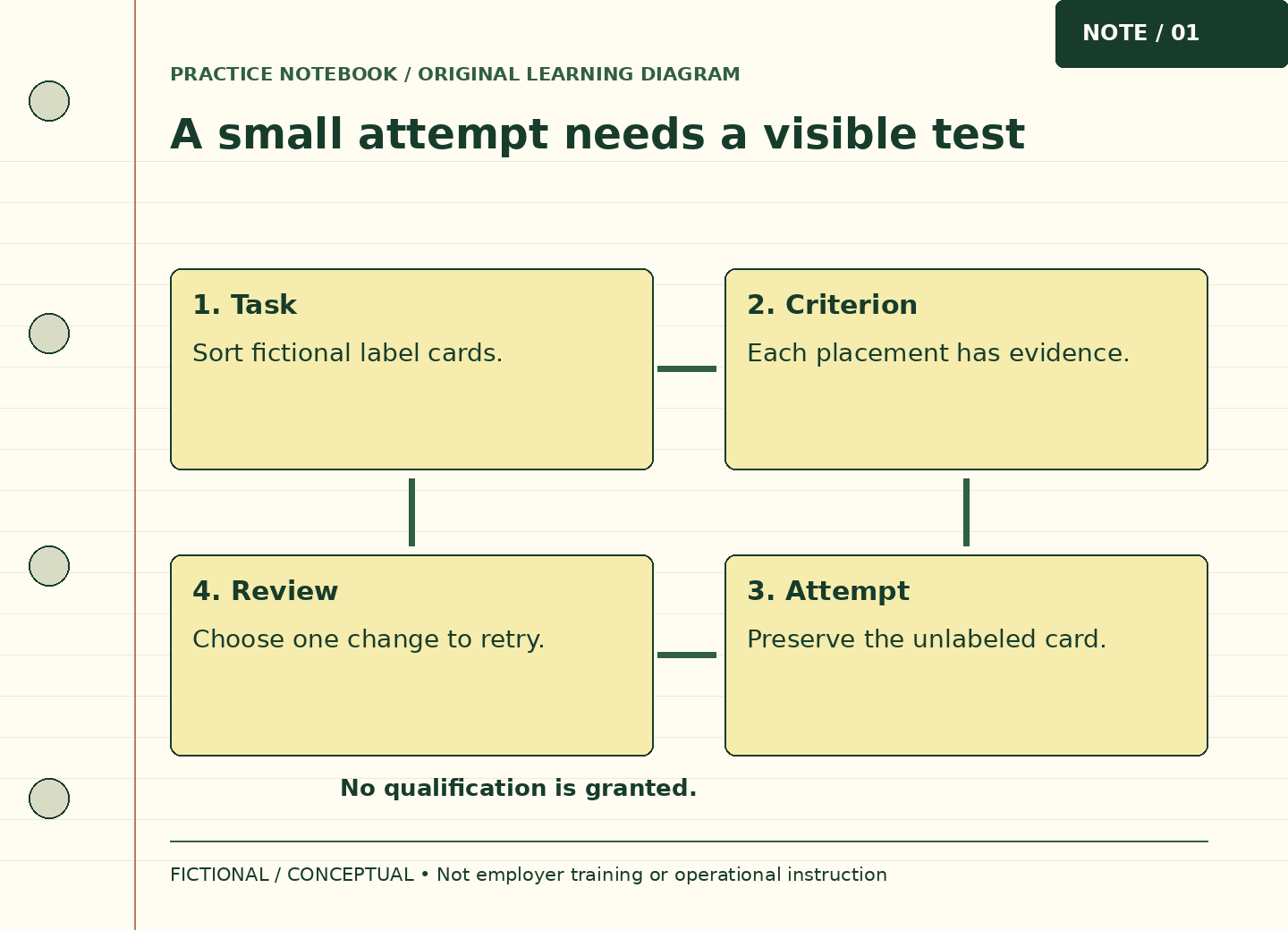
Imagine a community book swap with six blank label cards. Some cards identify a book category, some name a display table and one has no label at all. Your practice task is to group the cards according to a rule supplied in the exercise. There are no visitors, security controls, personal records or live consequences. You can inspect the classification without turning a workplace into an experiment.
Make the task smaller than the ambition. Rather than “organize everything,” try “place each card in the category supported by the printed label and leave the unlabeled card unresolved.” The unresolved card is valuable. It tests whether the learner recognizes a limit instead of hiding uncertainty behind a tidy output. A useful exercise can finish with an unanswered item.
Write the criterion before trying
For this exercise, the criterion might be: every assigned category has a matching printed label; the unlabeled card is identified as unknown. That is an observable rule. “Look professional” is not. The criterion should describe what the practice artifact needs to show, not a judgment about the person producing it.
Keep the reference rule separate from your attempt. Otherwise it is easy to change the rule after seeing what you did, then declare success. A small reference card can say what counts, what does not count and what remains undecidable. A disagreement with the exercise’s rule may be worth discussing, but it is different from applying the rule consistently.
Inspect the attempt, then choose one change
Suppose five cards were classified from their labels and the unlabeled card was placed with the largest group. The observation is not “bad attention.” It is that the final placement has no supporting label. A focused next attempt changes one thing: include an explicit unresolved space on the worksheet. Then use new invented labels to see whether that space helps you preserve the limit.
Do not count repeated exposure as improvement by itself. If the next attempt uses the same six cards in the same order, you may remember the arrangement rather than apply the rule. Change one surface feature, such as the label names, while retaining the criterion. Keep enough of the task stable to make the comparison meaningful.
Use the Practice Evidence Lab
The local tool combines three fixed harmless tasks with a practice method and a review focus. It returns a worksheet prompt, an inspection question and a boundary. There is no score, ranking or readiness label. A printout is a blank practice aid, not a completion record. You can also use the full no-script example below the controls.
Choose the classification exercise if you want to inspect evidence for grouping; choose the short reference card if you want to distinguish recall from checking; choose the version comparison if you want to notice what a revised rule actually changes. These are different practice targets, not interchangeable levels in a training program.
Keep practice separate from permission
Allied Universal’s public training article discusses learning objectives and evaluation. This independent exercise borrows neither its curriculum nor its authority. Required training, assessment, supervision and permission come through the applicable authorized process. Stop the personal exercise if it starts to require internal material or operational decisions.
For the next page, read how to write a learning objective. If you already have an attempt, use a feedback-and-retry record to choose the next change. Keep the artifact modest enough that another person can understand what was practiced and what was not.