In this article
Feedback is most useful when it changes the next attempt in a way you can inspect. “Be more careful” may express a concern, but it does not identify what to change. “The unlabeled card was assigned without evidence” is narrower. It points to a moment, an artifact and a criterion. This article keeps feedback inside an invented learning exercise, away from performance ratings or disciplinary judgments.
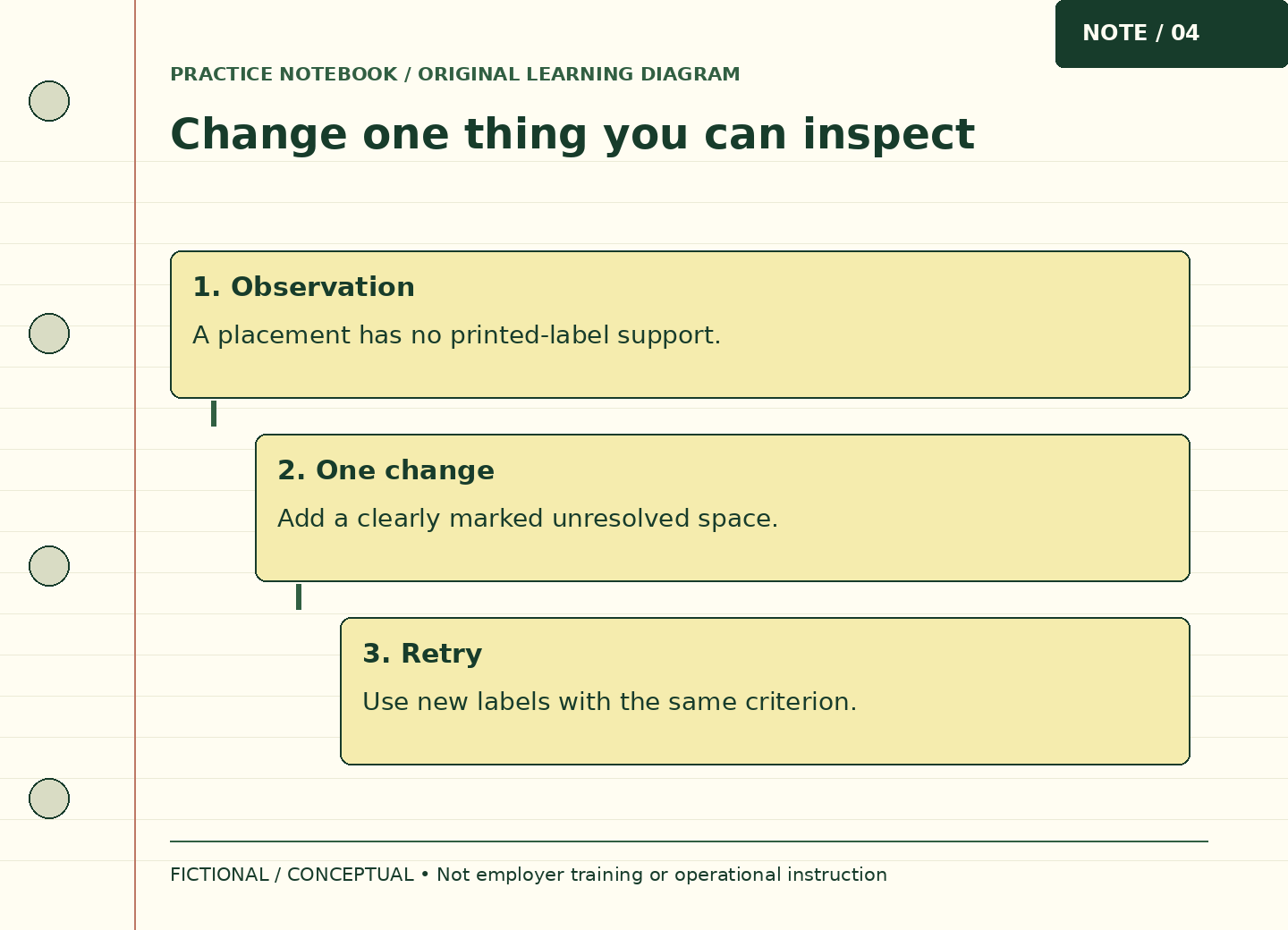
Separate the observation from its interpretation
In a fictional sorting task, a reviewer notices that two cards were grouped by color even though the reference uses the printed category. The observation is the grouping. A possible interpretation is that the learner treated color as the rule. Before deciding, ask the learner to explain the basis of the choice. They might instead have misread a heading or used a different reference card.
That distinction matters because the next attempt should address the actual difficulty. A larger font may help a reading problem; emphasizing the category criterion may help a rule-selection problem. Repeating the same advice for every mismatch can make practice feel busy without making it informative.
Choose one change you can describe
Suppose the learner confirms that color drove the grouping. One useful change is to add a first step that points to the relevant sentence on the reference card. Do not simultaneously add a timer, change every label, switch the display layout and introduce a second rule. Too many changes make it difficult to understand what affected the attempt.
One-change practice is an editorial simplification, not a law of training design. Some approved courses combine several conditions for good reasons. Here, controlling the change helps a reader inspect a small fictional task. When the learning requirement belongs to an employer or instructor, follow that requirement rather than replacing it with this notebook’s method.
Keep the original criterion visible
The retry should still be judged against the relevant rule. If success originally meant “every placement has printed-label support,” the second attempt should not suddenly be praised only for looking tidy. Improvement is a relationship between the attempt and a criterion. It is not the fact that the reviewer likes the new page better.
Record three short statements: the observed mismatch, the change attempted and what the new artifact shows. For example: “Color drove two placements. On the retry, I underlined the category rule first. All four placements now point to a printed category; the fifth card remains unknown.” This is a fictional illustration, not an achievement to claim as personal experience.
Handle disagreement without forcing a verdict
Two reviewers may emphasize different features. One may notice accuracy; another may notice legibility. Return to the objective before combining their comments. If both features matter, make them separate criteria. If the reference is contradictory, the responsible author needs to clarify it. A learner should not have to guess which reviewer’s preference secretly counts.
Some feedback is too broad, unsupported or outside the exercise. You can acknowledge it without turning it into a target. A personal comment about motivation is not evidence of a specific error. Keep the learning record about the work produced and the conditions under which it was produced.
Know when another retry will not help
If the learner lacks an approved reference, required access, an accessible format or necessary instruction, repeating the task may preserve the barrier. Stop and identify what support is needed. More effort cannot supply a missing authority or an unavailable format. See making the learning format usable before assuming the problem is practice volume.
Allied Universal’s public training article discusses evaluating training effectiveness. This original feedback record makes no employee-evaluation claim. Use it to shape a harmless next attempt, and keep actual assessments, sign-offs and employment decisions in the authorized process.