In this article
A checklist tells you whether items were ticked. A learning objective tells you what an attempt is meant to demonstrate. The two can support each other, but they answer different questions. Starting with the checklist often rewards visible activity: open a page, watch a clip, fill a box. Starting with an objective asks what the learner should be able to do with the idea.
Name the action, not the aspiration
Use an action that leaves something inspectable. Compare, classify, identify a missing premise or explain a limit are possible actions. “Understand thoroughly” is too broad to inspect on its own. This is not a ban on understanding; it is a way to choose a small window through which to examine it.
For an invented exercise, the action could be “identify the difference between version A and version B of a book-swap sorting rule.” The artifact might be two marked differences and one sentence about what remains unchanged. That is more useful than a goal to “be adaptable,” because it creates a specific task with a visible result.
Add conditions that make the task fair
A performance means something only in relation to its conditions. Is the reference available? Is the example familiar? Is the learner expected to remember the rule or compare it directly? A person who accurately compares two visible cards has demonstrated comparison, not necessarily unaided recall. Neither result is worthless, but they should not be mislabeled.
Write the condition in plain language: “With both fictional versions visible, identify every changed category rule.” Avoid artificial speed pressure unless speed is genuinely the subject and the exercise remains safe. A personal reading exercise does not establish the time limits that apply to an employer’s training or assessment.
Choose evidence without manufacturing precision
A criterion such as “each identified change points to wording in the revised card” can be inspected. A made-up score such as “eighty percent ready for work” cannot be justified by this small task. Count only what the exercise actually contains. If there are two relevant changes, the observation can say which were found and which were missed.
The criterion also needs a boundary. If the card does not explain why the rule changed, the learner should not invent a reason. You can make preserving that unknown part of the objective. An accurate output sometimes contains less confident prose than a weak one because it keeps unsupported claims out.
Check that the objective and exercise match
Read the objective beside the proposed activity. If the objective is comparison but the activity merely asks learners to copy version B, the evidence does not match. If the objective is identifying unsupported conclusions but every example supplies complete information, the exercise never tests that distinction. Change the activity rather than stretching the interpretation afterward.
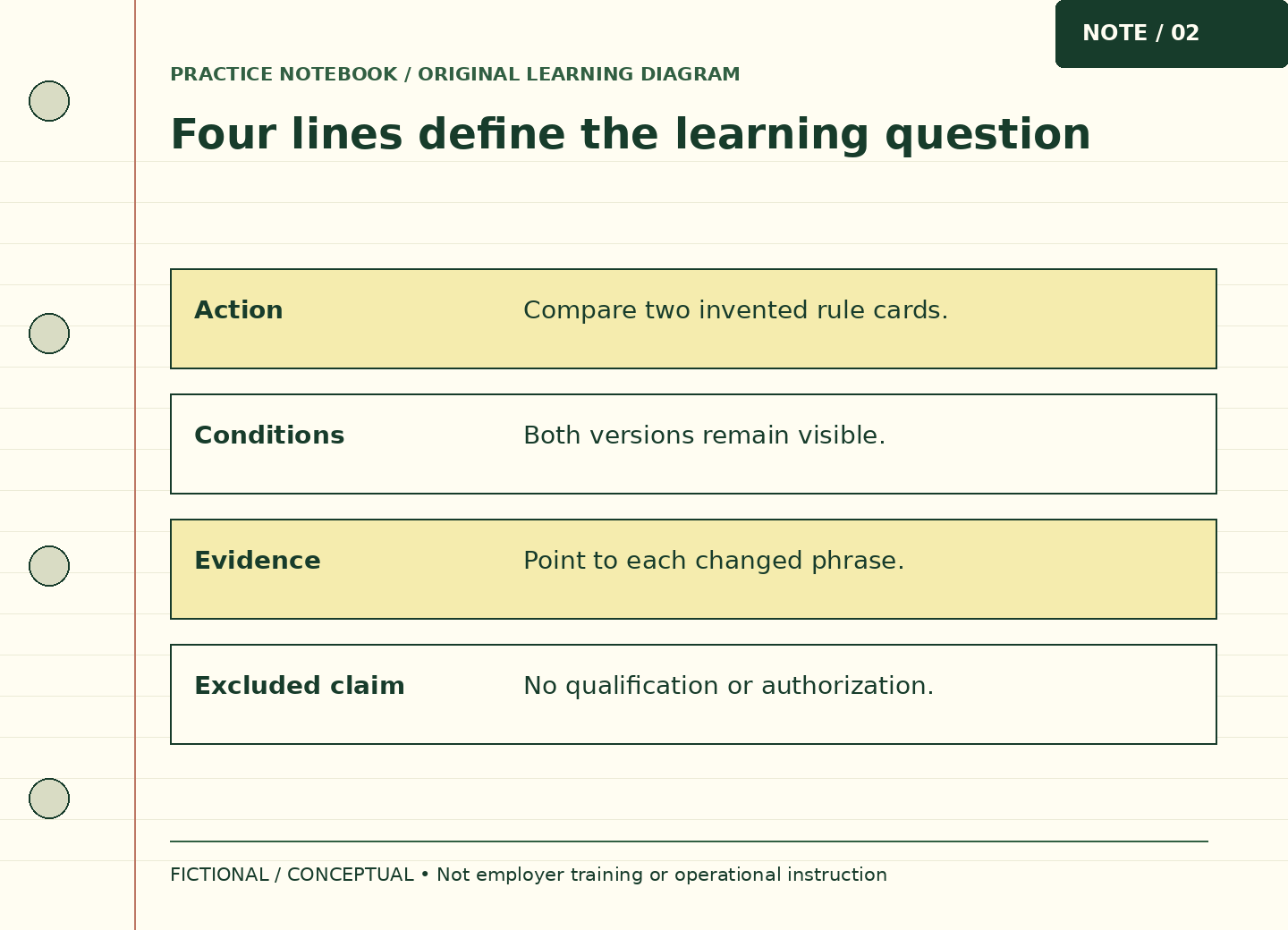
A practical worksheet has four lines: action, conditions, evidence and excluded claim. In the example: compare the two cards; both remain visible; mark each changed rule with its source wording; do not claim that the result proves authorization or general competence. That last line protects the meaning of the first three.
Revisit the objective when the task changes
A new condition can require a new objective. Removing the reference turns comparison into something closer to recall. Adding an ambiguous label introduces uncertainty. Do not compare attempts as if nothing changed. Note the new condition, then decide whether the original evidence still answers the learning question.
Allied Universal’s public training article includes learning objectives as part of training design. The four-line worksheet here is an original editorial device. It neither replaces an assigned objective nor sets an employer standard. Pair it with the reference-check exercise when deciding what a visible source should contribute.