In this article
Remembering a rule and checking a rule are different activities. An attempt from memory can reveal what you retained. A source check can reveal what the current text says. Combining them carelessly makes it hard to tell which activity produced the answer. This exercise separates them while keeping all examples harmless and invented.
Make a tiny reference card
Write three rules for a fictional craft-book display: blue labels belong on the upper shelf; yellow labels belong on the lower shelf; an unlabeled item remains unassigned. Add a revision marker, “Practice card A,” so the reference can be identified later. This is not a real shelf-management instruction. It is a small set of rules with enough detail to expose a missing condition.
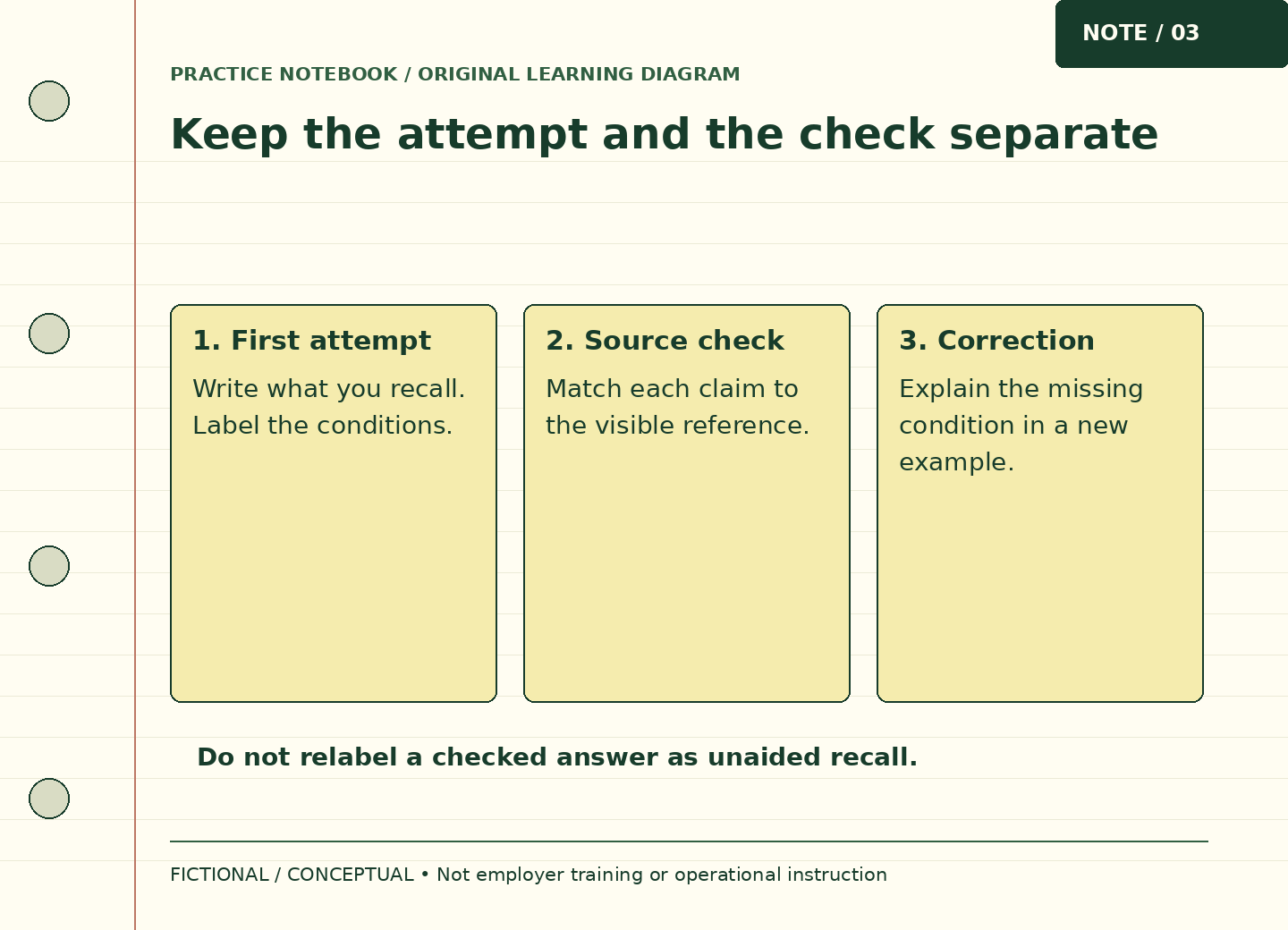
Read the card, set it aside and explain the three rules on a blank sheet. Mark the result “memory attempt.” Do not quietly reopen the card while writing and then describe the result as unaided recall. If you need to check it, that is useful information. Label the activity accurately rather than protecting a perfect-looking result.
Compare claims one at a time
Place the reference beside the attempt. Underline the part of the reference that supports each claim. A reversed shelf position is a mismatch. An omitted rule is a gap. A new claim that unlabeled items should go on the nearest shelf is an invention. Those observations lead to different next steps, even though each could be called an error.
Avoid converting the inspection into a personality judgment. The sheet shows what happened in one exercise under particular conditions. It does not prove that a person is careless, has a poor memory or cannot learn. Keep the record close to the evidence: “The unlabeled-item condition was missing from the first attempt.” That observation can be checked.
Correct the idea, not just the wording
A correction is stronger when it explains the distinction that was lost. Instead of only copying the third rule, note that a missing label does not supply a category. Then try a new fictional card with different colors and a different unresolved case. The new surface detail helps separate applying the distinction from memorizing the previous arrangement.
If the reference itself is unclear, do not guess what the exercise author intended. Mark the ambiguous phrase and stop that part of the task. An exercise can teach source checking by making a missing condition visible. It should not reward a confident answer to a question its reference cannot settle.
Choose the right method for the real context
This notebook is not recommending that workers operate from memory when current instructions need to be consulted. Real tasks may require an approved checklist, current document, instructor demonstration or supervision. Follow those requirements. A memory exercise outside operational work does not authorize testing unaided recall during a live assignment.
Likewise, having a reference open does not prove that it is current or applicable. The version-comparison article explains how to separate a text change from a permission to use it. In actual training, the authorized source determines which version applies and how updates are acknowledged.
Record what the attempt established
A useful conclusion is narrow: “With the fictional card visible, I found the omitted unresolved-item rule and corrected the example.” That statement distinguishes the initial attempt, the check and the correction. It does not claim durable retention or workplace readiness.
Allied Universal’s public careers site supplies workforce context for this collection. The card, labels and checking method are original examples. Keep a second attempt only if it answers a specific question, such as whether the missing condition is recognized with new labels. A pile of repeated pages is less informative than one clearly documented comparison.