In this article
A revised document can look familiar while changing one important condition. The challenge is not simply to notice a new date. It is to identify what changed, what that change means within the document and what the document does not settle. The exercise here uses a fictional book-display rule, so the comparison never reveals or modifies workplace procedures.
Put the versions side by side
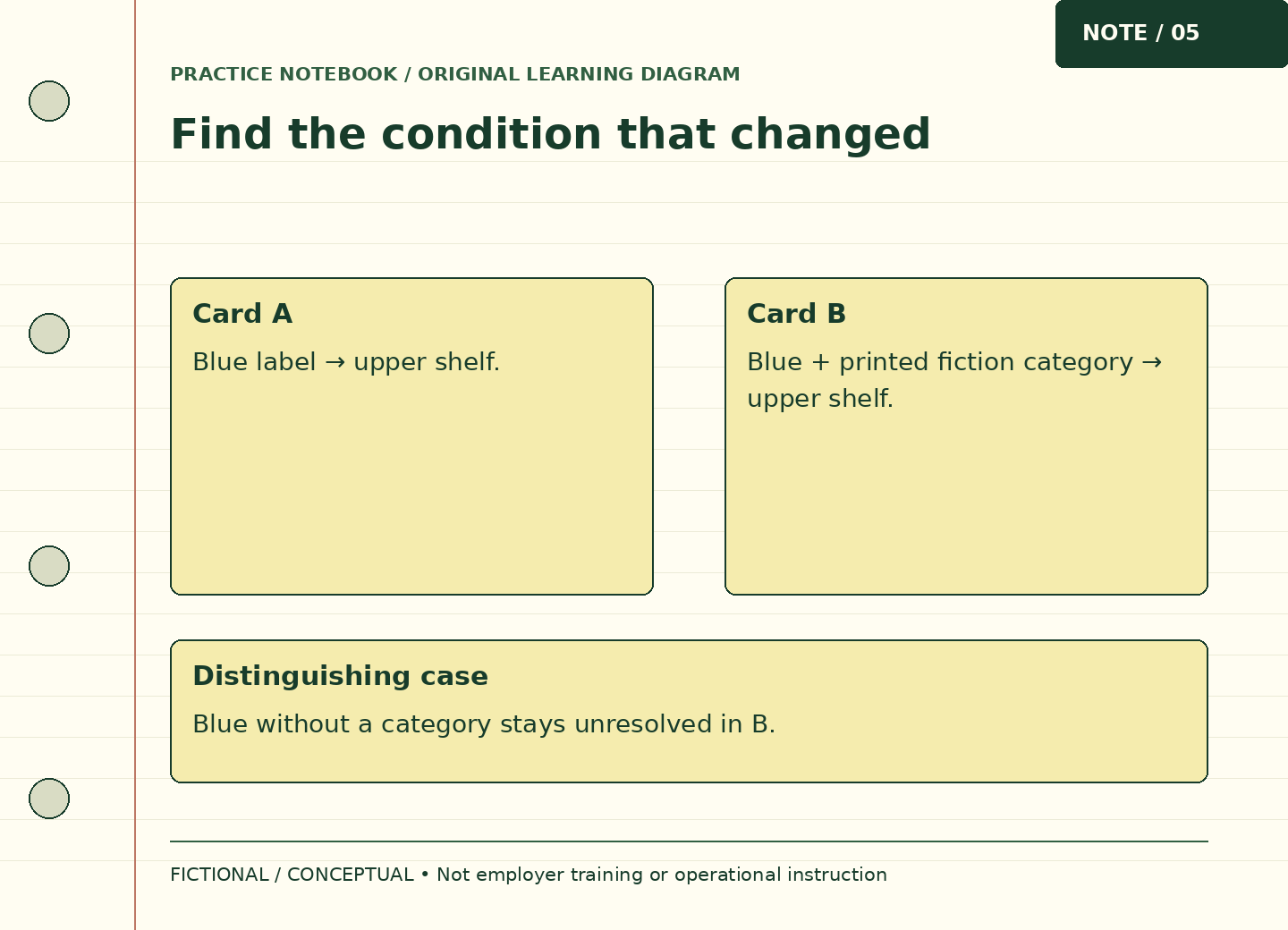
Practice card A says that all blue-labeled books go on the upper shelf. Practice card B says that blue-labeled books with a printed fiction category go on the upper shelf; other blue-labeled books remain unresolved until a category is supplied. The color is unchanged, but the condition is different. Reading only the familiar opening words would miss the new qualification.
Keep both cards visible and identify them as A and B. Do not overwrite the first card before the comparison is finished. A comparison needs the old text, the revised text and a clear relationship between them. In actual work, use approved version-control and document-retention practices; this personal exercise is not permission to copy internal material.
Describe the change before its consequence
The text change is the addition of a printed-category condition. The consequence inside the fictional exercise is that color alone no longer supports placement on the upper shelf. Those are connected statements, but they are not the same. Separating them makes the explanation easier to check against the wording.
A third statement, such as “the organizer changed this because last week went badly,” has no support. Neither card gives a reason. Leave it out. Source literacy includes recognizing that an accurate comparison can explain the new condition without explaining the author’s motive.
Test a case that exposes the difference
Use two new fictional items: a blue label with “fiction” printed on it and a blue label without a category. The first item fits both versions. The second distinguishes them. If all examples satisfy both versions, the exercise cannot show whether the learner noticed the change. Choose an example that makes the changed condition matter.
Also test an unchanged case. A yellow-labeled book may follow a separate rule that remains identical in A and B. This protects against another common mistake: treating one change as if the entire document had been replaced by an unrelated system. A good comparison names continuity as well as change.
Do not confuse a new date with applicability
A newer document is not automatically the applicable document for every person, role or location. A date can help identify a version, but scope and authority still matter. In an actual training setting, ask the authorized source which version applies and whether a revised instruction requires additional training or acknowledgement. Do not improvise a transition process from this exercise.
The public Allied Universal training article notes that changing circumstances can affect training needs. That general context does not identify any current employee’s instruction. This notebook deliberately avoids reproducing real operational materials, even when a generic-looking comparison might seem convenient.
Leave a trace another reader can follow
A concise comparison record has four lines: old condition, new condition, distinguishing example and unresolved question. In this exercise the unresolved question may be empty because the cards fully define their fictional task. In a real setting, a blank field should never be used to hide an applicability issue that has not been answered.
Use the learning evidence log to record the comparison without private content. If your goal is to remember the new condition later, make that a separate attempt using a purposeful return to an idea. Comparing successfully today does not automatically establish retention tomorrow.